From Ledger Entry to Public Record: Why Minutes Took Their Shape
Meeting minutes record formal decisions and follow-up, not every exchange. Learn to read their wording carefully and find related papers when context matters.
The common mistake when reading meeting minutes is to expect a shortened transcript. That can make a concise record seem evasive: the discussion that shaped a decision may be absent, even when the formal outcome is clear. Meeting minutes are best read as records of proceedings and actions, not as accounts of every sentence spoken.
Purpose before history
There is no single history that explains how all meeting minutes took their present form. Institutions keep records under different rules and traditions, and a council’s minutes may serve different needs from those of a club or professional board. A useful distinction is practical: minutes organise information about a meeting so readers can identify the business considered and the actions recorded.
That purpose helps explain why minutes commonly list attendance, agenda items, motions, votes and follow-up instructions without reproducing debate. The format favours an account that can be consulted later for official outcomes. A transcript, by contrast, aims to preserve spoken words, though its completeness depends on how it was made.
Decisions and dialogue
Minutes commonly prioritise the matter considered, the formal action and its result. A record that a motion was made and carried can establish what the body decided without preserving arguments for or against it. It may also name a person responsible for follow-up, making the entry useful after the meeting.
Concise wording has limits. A formal outcome can be clear while the reasons, range of views and tone of the discussion remain unknown. When those details matter, consult related records such as the agenda, staff report, published recording or separate decision notice.
Verbs and decisions
Read the verbs closely. “Received” may mean a report was presented, not that its claims were endorsed; “noted” can record awareness without a decision. “Resolved”, “approved” or “authorised” more directly indicate formal action, though the precise meaning depends on the body’s procedures.
Check how a motion and its result are recorded. Minutes may state the motion’s wording and outcome but omit the debate. “Carried” identifies a result, but does not necessarily name who voted for or against it; look for a recorded division or named votes before drawing conclusions about individual positions.
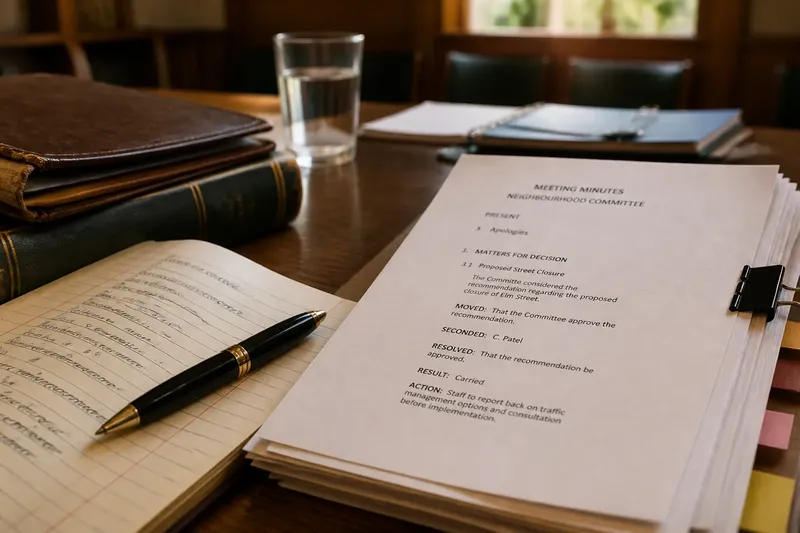
Say you are reading a neighbourhood committee’s minutes about a proposed street closure. The entry says the committee approved a recommendation and asked staff to report back, but does not reproduce the discussion. You can conclude that the recommendation was approved and a further report requested; you cannot conclude that every member supported the same reasons.
Reading minutes carefully?
Are minutes a transcript?
No. Minutes are usually a selective account of proceedings and decisions, while a transcript aims to reproduce spoken exchanges. A recording or transcript may be available separately, depending on the organisation.
Why is debate left out?
Minutes record formal business in a manageable form rather than capturing every contribution. A sparse entry does not establish that discussion was absent; the level of detail reflects the body’s rules and practice.
Can minutes show who voted against?
Sometimes they name individual votes or dissent; sometimes they provide only the overall result. Check for a recorded division, a list of votes or relevant procedural notes before attributing a position to a particular person.
Where can I find fuller context?
Check the meeting agenda and papers, any published recording, and later records that refer to the decision. These sources may explain the issue or document follow-up, but they do not alter what the minutes formally record.
Limits of the record
A brief entry may omit a technical concern, a condition attached to an approval or the reason a matter was deferred. Search the surrounding agenda items and subsequent minutes for references, rather than treating one sentence as the whole history.
What is not worth the effort is trying to infer participants’ private views from a neutral summary. Minutes can support claims about recorded actions, stated motions and documented votes; they are a poor substitute for evidence of unrecorded motives. If a consequential question remains, ask the relevant records office how the decision was documented.
A careful reading habit
For meeting minutes, separate the subject under consideration, the formal decision and any follow-up action. Mark the exact words used for each, so that “heard a report”, “agreed a recommendation” and “instructed staff” do not blur into a claim that the body approved everything discussed.
Then compare the entry with its date, agenda heading and later references. Meeting minutes are a useful guide to what was formally done, not a complete account of conversation. When you need to understand how a decision was reached, use the related records as well as the minutes.